
Why Rumors of Kim Jong-un's Death Could Be a Decoy
The best bait is "Breaking News."
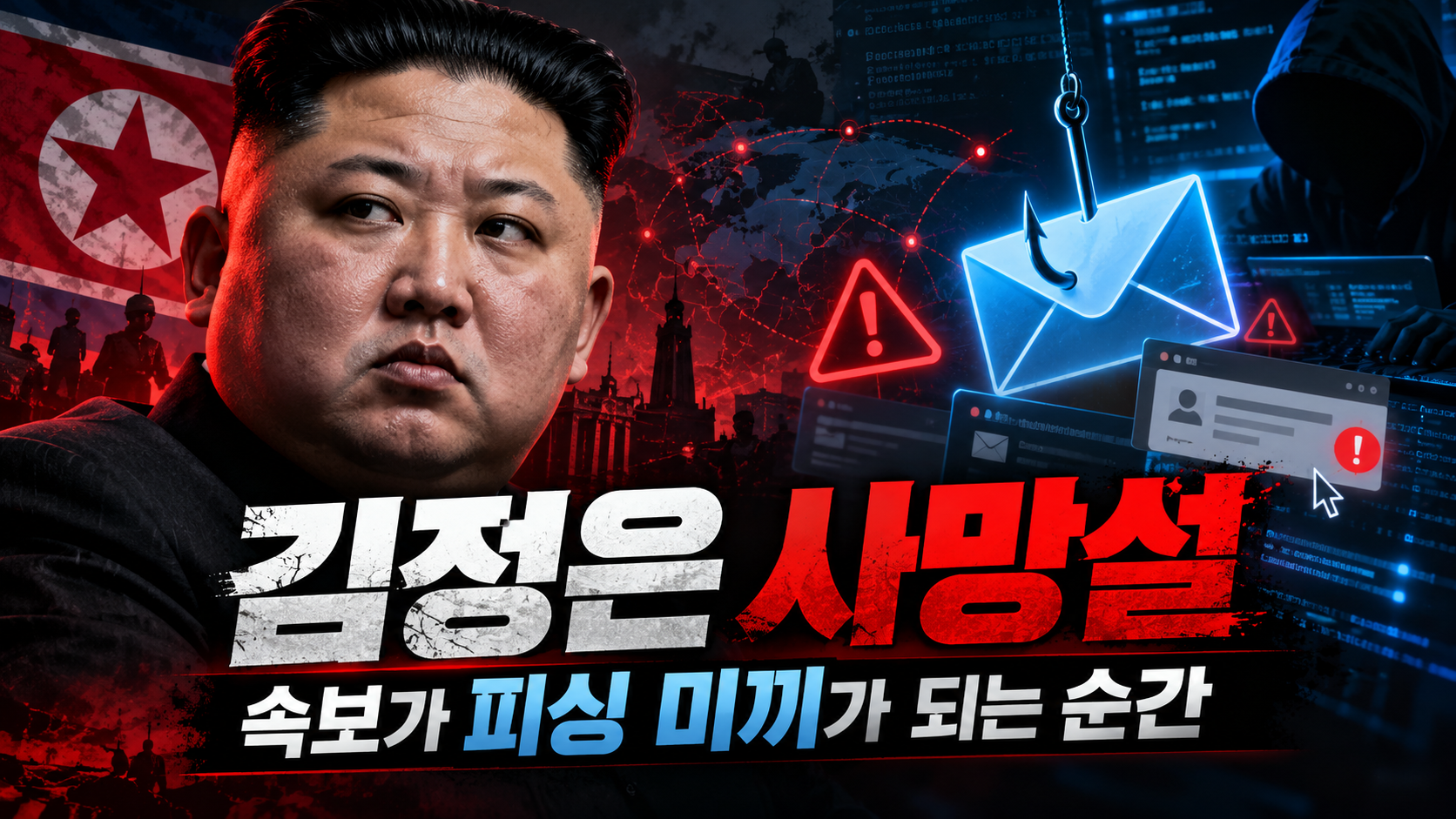
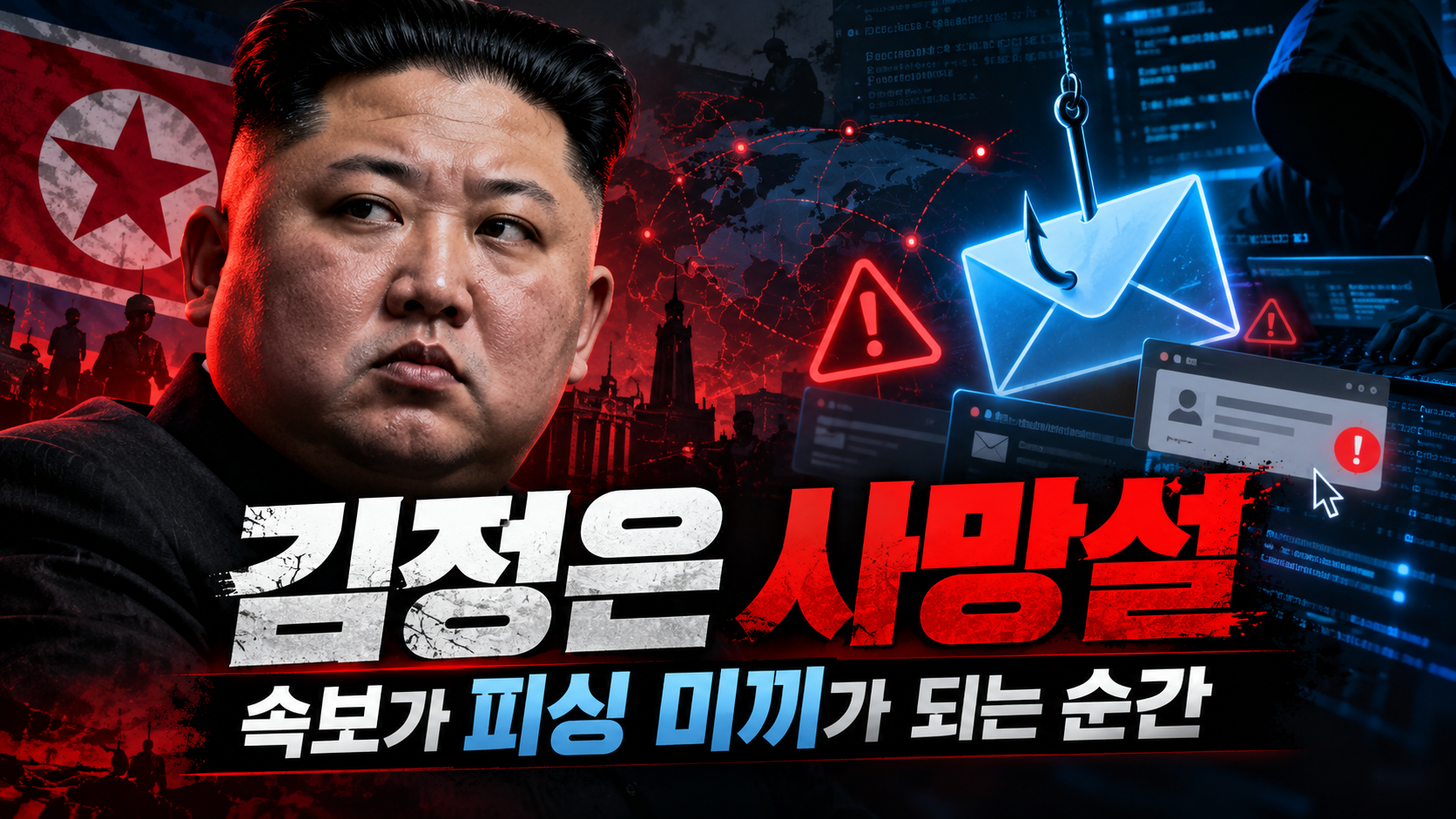
On the day rumors of Kim Jong-un's death surfaced,
why should the security team check their inboxes before reading the news?
— The moment “Breaking News” becomes the best bait for an APT
Around October 20, 2026, a story like this suddenly began spreading on social media platforms overseas.
It claimed that Kim Jong-un had collapsed from a cerebral hemorrhage, was transported to Beijing, fell into a coma, and eventually died.
Soon after, claims followed that Kim Yo-jong had seized power or that Chinese troops had entered North Korea.
However, there was no concrete evidence. Online communities were abuzz, and defense sector stocks even took a hit.
I’m invested in defense stocks… T_T
On October 23, the National Intelligence Service reported to the National Assembly’s Intelligence Committee that it had determined the death rumors were untrue. North Korean state media also reported that Kim Jong-un had visited an exhibition in Pyongyang on the 19th.
From an intelligence perspective, this is where the disinformation incident ends.
However, when viewed from the perspective of a security team, this incident raises a slightly different thought.
“I bet this will show up as a phishing email subject line within a few days.”
That’s because the bait that attackers love has one thing in common:
It has to pique people’s curiosity,
it has to make you feel like you need to open it right away,
and it has to be related to their daily work.
The rumors of Kim Jong-un’s death almost perfectly satisfy all three of these conditions.
Starting with an important premise,
Based on currently available public information,
this does not mean that a specific malware campaign exploiting the October 2026 Kim Jong-un death rumor has actually been confirmed.
This article
Rumor
   |
   v
Confirmed Malware Campaign
is not an article making that claim.
Instead, it is an analysis of this structure.
Breaking Geopolitical Event
          |
          v
High Public Interest
          |
          v
Targeted Social Engineering
          |
          v
Credential Theft / Malware
Furthermore, this approach is not merely a hypothesis.
It is quite similar to patterns that North Korea-linked threat groups have already used repeatedly.
Why do attackers prefer “genuine interest” over “fake news”?
When people think of phishing, this is what often comes to mind.
Your account has expired.
Click here to verify your password.
These days, targeted attacks are much more subtle.
Especially if the target
Journalist
Researcher
Government Official
Policy Analyst
Think Tank Staff
Defense Researcher
the same person,
a breaking news story about North Korea makes a much better bait than an out-of-the-blue text about a package delivery.
A joint advisory released in 2023 by the U.S. FBI and NSA, along with South Korea’s National Intelligence Service, National Police Agency, and Ministry of Foreign Affairs, explained that attackers affiliated with the Kimsuky group impersonate or target journalists, scholars, and think tank researchers, and update their phishing content to align with the latest issues being discussed within the North Korea expert community.
This is a key point.
Attackers don’t necessarily have to fabricate lies from scratch.
They simply need to take topics that people are already discussing online.
For example, imagine receiving an email with a subject line like this:
Imagine you work at a research institute focused on North Korea.
This email arrives on a day when rumors of his death are spreading like wildfire.
Subject: Urgent Briefing — Leadership Transition in North Korea

Attached:
DPRK_Leadership_Assessment_20261020.zip
Under normal circumstances, you might be suspicious of the ZIP file itself.
But the situation is different now.
For the past few hours, the same story has been circulating on X and various news sites.
Moreover, the sender appears to be a journalist or researcher you know.
The body of the email reads naturally, too.
Could you review the attached assessment before today's briefing?

We are collecting expert opinions regarding the reports
of a possible leadership transition in Pyongyang.
It aligns perfectly with the nature of my work.
This is why spear phishing is more dangerous than regular phishing.
It’s not about technically perfect deception; it’s about creating a contextual reason to click.
In fact, there have already been similar attacks
June 22, 2026.
An attack was discovered in which an actor, analyzed as being linked to APT37, attempted spear phishing targeting professionals in the research, policy, and academic fields.
The bait was not a fictional event.
It was actually a proceedings booklet from a North Korea-related academic event held in Seoul.
The attacker crafted the email using publicly available information, such as the event name and the organizing institution.
From the recipient’s perspective, it appeared to be an event they would actually be familiar with.
When the link was opened, it appeared to be a PDF, but what was actually delivered was a malicious ISO file, and the executable file inside was disguised to look like a document.
To simplify the attack sequence, it went like this.
Real-world Event
      |
      v
Legitimate-looking Email
      |
      v
Cloud Storage Link
      |
      v
Fake Document
      |
      v
Payload Execution
      |
      v
RokRAT
The key isn’t the malware itself.
The key is how the attacker induced that initial click.
Why issues like rumors of Kim Jong-un’s death are particularly dangerous
Standard security training advises the following:
“Don’t open attachments from unknown sources.”
That’s not wrong.
However, in actual targeted attacks, there’s a reason why the victim needs to open the attachment.
If you’re a reporter,
Exclusive Photosyou’d be curious about a file like that.
If you’re a North Korea researcher,
Leadership Transition Assessmentyou’d have a reason to open it.
If you’re a government official,
Emergency Situation Reportit’s hard to ignore this document.
And for those in the security industry, files like this are actually even more dangerous.
DPRK_Incident_IOC_Report.pdfSince you’re a security professional, you open security documents.
Attackers essentially exploit job responsibilities as a vulnerability.
From the security team’s perspective, “Breaking News” is an IOC.
Let’s shift our perspective a bit here.
When the security team talks about an IOC, they usually think of something like this.
IP Address
Domain
File Hash
URL
Registry Key
Process Name
However, when you’ve been doing threat hunting for a long time, you can view the issue itself as an indicator.
For example, rumors of Kim Jong-un’s death suddenly broke out on a large scale.
Starting that day, the SOC can monitor whether the frequency of such keywords increases in email logs.
Kim Jong Un
DPRK
North Korea
death
brain hemorrhage
leadership transition
succession
emergency briefing
intelligence report
We don’t block traffic simply because these keywords are present.
Instead, we raise the priority level compared to normal.
Breaking Topic
      +
External Sender
      +
Attachment
      +
New Domain
      +
Targeted Recipient
      |
      v
High-Priority Review
This is where news and threat intelligence intersect.
A true Senior Security Engineer would first check the email gateway.
One of the first things you can do on the day such an issue breaks is to check recent inbound email.
This is especially true for organizations with personnel involved in North Korea, diplomacy, or security.
I look at the following elements together.
Sender Reputation
Domain Age
SPF
DKIM
DMARC
Reply-To
Attachment Type
URL Reputation
Recipient Role
Message Similarity
For example, if the “From” field appears to be from a legitimate research institution,
From:
researcher@example.org
but the actual “Reply-To” address is a completely different, new domain, the situation changes.
Reply-To:
analysis-team@external-example.net
If, on top of that,
.zip
.iso
.lnk
.pif
.scr
if a file transfer is involved, the priority for verification rises sharply.
“But there’s no malware in the email, right?”
Modern attacks don’t necessarily deliver malware in the very first email.
In fact, the first message is often completely ordinary.
Hello,

We're preparing a short expert briefing regarding recent
developments in North Korea.

Would you be available to provide a brief comment?
There are no attachments.
No URLs either.
From the perspective of security systems, it looks completely normal.
The user replies.
Only then does the attacker send the second message.
Thank you.

I've attached the background material for your review.
This method can be considered “pretexting.”
It involves first establishing a context between people and then delivering the actual payload.
An analysis of APT37 also revealed that in 2026, the group identified targets via Facebook, established friendships, and then moved to Messenger, using specific topics as bait.
In other words, the attack flow was
Malware
   |
   v
Victim
is not
Reconnaissance
      |
      v
Conversation
      |
      v
Trust
      |
      v
Payload
.
This is why it’s difficult to block such attacks with email security solutions alone.
And in 2026, AI was added to the mix
There’s another change to note here.
The cost of creating decoy documents has dropped dramatically.
In an analysis of Kimsuky-related activities conducted by Genians in September 2026, traces of “opencode”—an open-source AI coding agent—were found in some of the decoy PDFs distributed alongside malicious LNK files.
The analysis also revealed evidence suggesting that HTML-based documents were automatically generated and then converted to PDF using Headless Chrome.
In the past, attackers had to create a plausible document themselves.
Now,
Topic
  |
  v
LLM
  |
  v
HTML Template
  |
  v
PDF
it has become much easier to mass-produce them in this format.
This becomes particularly problematic when breaking news—such as rumors of Kim Jong-un’s death—suddenly surfaces.
If a news story breaks at 9:00 a.m.,
attackers don’t need to wait until the afternoon.
The speed at which decoy documents are created can keep pace with the news cycle.
Therefore, “the document’s content seems plausible” is no longer a reliable indicator of authenticity.
Phishing emails used to have certain characteristics.
The sentences are awkward.
The translation sounded awkward.
The design was shoddy.
The logo was pixelated.
These days, the value of such indicators continues to decline.
Good Grammar != Legitimate

Professional PDF != Legitimate

Correct Branding != Legitimate

Relevant Topic != Legitimate
Especially when it comes to AI,
to a North Korea expert, it looks like a North Korea expert,
to a security team, like a security firm,
and to a journalist, like a journalist,
to a North Korea expert, a security firm to a security team,and a journalist to a journalist.
Therefore, the defense must focus on the execution process rather than the naturalness of the content.
"The document looks normal, but the subsequent process is suspicious."
In EDR, these connections are far more important.
Mail Client
     |
     v
Archive
     |
     v
LNK
     |
     v
PowerShell
     |
     v
Network Connection
Or
Explorer
   |
   v
Unexpected Executable
   |
   v
Scheduled Task
   |
   v
External C2
In the 2026 analysis related to Kimsuky, patterns were also identified where LNK files led to PowerShell execution, the creation of hidden scheduled tasks, or the use of GitHub raw content to deliver subsequent payloads.
In such attacks,
File Nameit is
Process Treeis often more reliable.
If I had observed this situation at the SOC,
let’s say rumors of Kim Jong-un’s death suddenly began circulating widely.
The security team wouldn’t necessarily
“Is this news true?”
right away.
That’s a matter for intelligence agencies and the media to determine.
The security team’s question is slightly different.
“Have attacks exploiting this issue begun within our organization?”
So first, we check whether there’s been a sudden increase in emails related to this topic.
Next, we look at who the recipients are.
Executives
Government Relations
Security Team
Researchers
Journalists
Policy Staff
Then we check for attachments or URLs.
If necessary, we correlate processes created during the same time period using EDR.
Email
  |
  v
Attachment
  |
  v
Execution
  |
  v
Network
This is how we build a single timeline.
The Intersection of Disinformation and Cyberattacks
The NIS determined that the rumor about the death was unfounded.
However, from a security perspective, the truth of the matter is not the only important factor.
It is also important whether people were prepared to believe it.
In a cyberattack, the information doesn’t necessarily have to be true.
It just needs to be plausible enough to make people click.
Truth
  |
  +----------------+
                   |
Rumor              |
  |                |
  +-------> Attention
                |
                v
             Curiosity
                |
                v
              Click
That is why, when a geopolitical crisis or breaking news occurs,
information warfare,
disinformation,
social engineering,
cyber espionage
become increasingly blurred.
This is particularly true in the North Korea-related sector.
In joint cybersecurity advisories, Kimsuky has been described as targeting journalists, scholars, and researchers who deal with North Korea-related policy and diplomatic issues as its primary intelligence-gathering targets.
This trend continued into 2026.
In fact, a RokRAT attack was detected that misappropriated materials from North Korea-related academic events, and
and activities linked to APT37 were analyzed, in which NarwhalRAT was delivered by spoofing Microsoft security advisories. This malware was capable of keylogging, screen capture, USB data collection, and remote command execution.
In other words, for attackers, **“the latest information on North Korea”** is not merely news.
It is also social engineering material used to initiate conversations with specific targets.
Ultimately, the most dangerous attachments aren’t the suspicious ones—
Security training often advises:
“Do not open suspicious files.”
However, in sophisticated targeted attacks, the opposite is true.
The most dangerous files are
the ones you have more than enough reason to open.
Breaking_Report.pdf

Emergency_Briefing.zip

Leadership_Transition_Assessment.pdf

DPRK_Intelligence_Update.pdf
It matches that day’s news exactly.
It’s exactly what I’m working on.
The sender even looks like someone I know.
So you open it.
After all, an attacker isn’t trying to
Executeto press a button.
Instead, they first
This makes sense.in their mind.
What security teams need to protect is context, not just files.
To prevent such attacks, it’s not enough to just chase after IOCs.
Domains change.
File hashes change, too.
File names change, too.
Especially when using AI, new decoy documents can be generated continuously.
Conversely, there are things that rarely change.
Target Selection
      |
      v
Pretext
      |
      v
Initial Access
      |
      v
Execution
      |
      v
Persistence
      |
      v
Command and Control
Namely, TTPs.
So, from a senior security engineer’s perspective,
Should we block the string
"Kim Jong Un"?
Rather,
it is far more important to ask, “What actions might an attacker take by exploiting this vulnerability?”
is far more important.
Summary
The National Intelligence Service ultimately determined that the rumors of Kim Jong Un’s death were unfounded.
However, from a cybersecurity perspective, this is a rather interesting case.
Even if the news isn’t true,
the moment people take an interest in it, a new attack surface emerges.
Breaking News
      |
      v
Public Attention
      |
      v
Targeted Pretext
      |
      v
Trust Building
      |
      v
Malicious Delivery
      |
      v
Initial Access
In fact, North Korea-linked APTs have consistently used spear-phishing attacks targeting North Korea experts, researchers, and journalists, incorporating the latest current events and information on actual events.
And AI is accelerating the production of these attacks.
So, when a major international news story breaks,
news teams verify the facts,
intelligence agencies must assess the authenticity of the information,
but security teams must ask a different question:
“Is someone using this news story right now to lure our employees into clicking on a link?”
Sometimes, the thing that gets weaponized the fastest in security isn’t a new CVE.
It’s this morning’s headline.
 끝까지 읽었네… 메밀 승인 🐾